

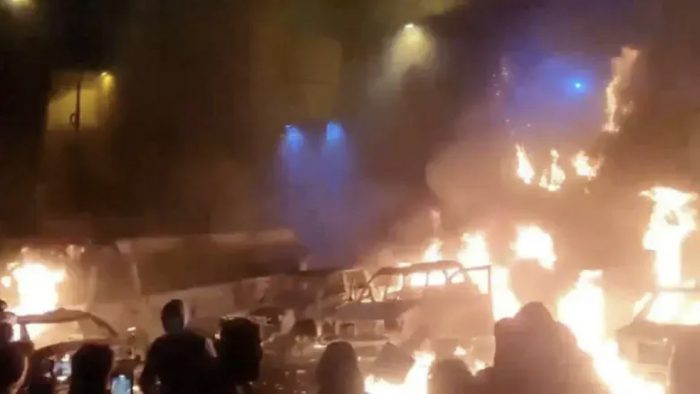
Israel’s precision strikes expose Iranian regime and terror proxies, shattering threats fueled by Arab forces.
The Israel Defense Forces carried out a sweeping and highly coordinated series of airstrikes over the weekend targeting Iranian military assets and Hezbollah terror infrastructure across Iran and Lebanon. The large-scale campaign demonstrated Israel’s expanding operational reach and its determination to dismantle the military capabilities of Tehran and its regional proxy network.
According to an operational summary released by the IDF, Israeli forces struck more than 300 strategic targets inside Iran while simultaneously attacking over 170 Hezbollah positions across Lebanon. The campaign unfolded through dozens of major strike waves conducted by the Israeli Air Force, hitting multiple fronts in a synchronized effort designed to cripple command structures, weapons storage facilities, and missile deployment capabilities.
Inside Iran, Israeli aircraft concentrated their firepower on Tehran and surrounding strategic zones linked to the regime’s missile and command infrastructure. Targets included both above-ground and underground missile depots, numerous ballistic missile launch systems, and facilities connected to the regime’s military leadership. Israeli officials confirmed that dozens of ballistic missile launchers were dismantled and a significant number of Iranian military personnel were eliminated during the strikes.
One of the most notable targets destroyed during the operation was a fortified underground bunker associated with Iran’s late Supreme Leader Ali Khamenei. The bunker, situated beneath the regime’s central leadership compound in Tehran, had reportedly served as an emergency command center for senior officials following Khamenei’s death in earlier Israeli strikes last week. Israeli officials described its destruction as a critical blow to the regime’s command and control capabilities.
Additional Iranian targets included headquarters belonging to a special regime unit operating in Alborz province, multiple bases connected to the Basij militia and internal security forces, and aircraft operated by the Islamic Revolutionary Guard Corps’ Quds Force. Israeli strikes reportedly destroyed sixteen aircraft used for transferring weapons to Hezbollah, further disrupting Tehran’s regional supply network.
At the same time, Israeli air power struck extensively across Lebanon. Dozens of waves of airstrikes targeted Hezbollah infrastructure in Beirut, southern Lebanon, and the Beqaa Valley. These attacks hit rocket launch platforms, weapons warehouses, command facilities, and an IRGC Air Force headquarters operating in the Lebanese capital.
The IDF also confirmed the elimination of several Hezbollah commanders during strikes in Beirut, along with the killing of a Hamas commander located in the northern Lebanese city of Tripoli. Israeli officials stated that the operations were aimed at systematically dismantling the terror leadership structures responsible for attacks against Israel.
The extensive campaign marks one of the largest coordinated Israeli strike operations across multiple regional fronts in recent years, significantly degrading the operational capabilities of Iran’s military apparatus and its proxy forces.


