
Relentless American and Israeli military pressure exposes Iran’s weakness while terror allies face unstoppable retaliation.
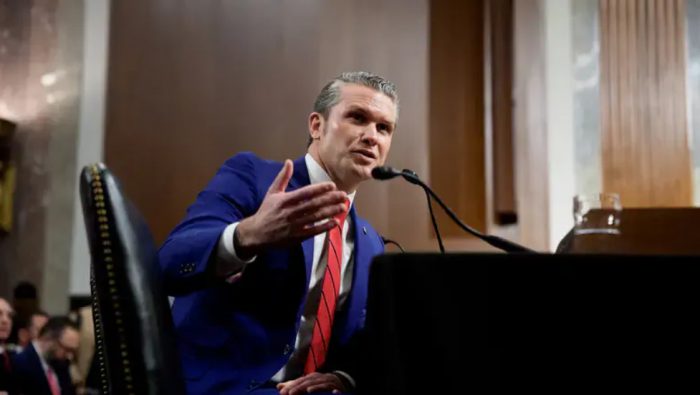
US Secretary of War Pete Hegseth declared that President Donald Trump’s demand for Iran’s unconditional surrender will ultimately be achieved, regardless of whether Tehran publicly acknowledges defeat. Speaking in an interview with CBS News’ 60 Minutes, Hegseth emphasized that the ongoing military campaign against Iran is only in its early stages and that the pressure on the regime will intensify dramatically.
Hegseth revealed that US forces have already struck approximately 3,000 targets across Iran as part of the expanding conflict. According to him, the scale of American military power being deployed is designed to systematically dismantle Iran’s ability to continue fighting.
He described the objective in direct terms, stating that the conflict is about forcing the enemy to its knees. Whether the Iranian regime chooses to formally surrender in a public ceremony or simply collapses under military pressure, he indicated that the final outcome will remain the same.
The Secretary of War explained that Iran had an opportunity to step back after the June airstrikes on its nuclear program during Operation Midnight Hammer. Instead of abandoning its nuclear ambitions and negotiating seriously, Tehran continued pursuing its weapons program, which he said forced Washington to escalate the campaign.
Hegseth also rejected claims that Israel pushed the United States into the conflict. He stressed that the decision to confront Iran was based entirely on American strategic interests and decades of hostility from the Iranian regime.
According to Hegseth, the Iranian government has spent nearly half a century targeting American interests and maintaining nuclear ambitions that threaten global security. The current military campaign, he said, reflects a generational effort to neutralize that threat permanently.
He highlighted the overwhelming military advantage of the United States and Israel, noting that the combined air power of the US Air Force and the Israeli Air Force represents the two most dominant aerial forces in the world. This superiority, he explained, ensures that the conflict will remain decisively in favor of the allied coalition.
While no US ground forces have yet been deployed inside Iran, Hegseth refused to rule out the possibility. He stressed that the United States will not publicly disclose operational limits and will go as far as necessary to ensure victory.
The war has already expanded beyond Iran’s borders. Tehran has launched missiles and drones into multiple Middle Eastern countries including Qatar, Bahrain and Saudi Arabia, further destabilizing the region and drawing additional attention to the regime’s aggressive behavior.
Hegseth also confirmed that the United States intends to secure the Strait of Hormuz, a strategic waterway through which roughly twenty percent of the world’s oil supply flows. He stated that American naval and air power will ensure the route remains open despite Iranian attempts to disrupt global energy markets.
He noted that Iran’s naval capabilities have been severely degraded, with much of what remained of the Iranian navy already destroyed during the conflict. According to Hegseth, additional Iranian vessels will likely be sunk as the campaign continues.
The conflict has also resulted in American casualties. Several US Army reservists were killed in an Iranian drone attack in Kuwait earlier this month. Hegseth acknowledged that further casualties are possible but stressed that such sacrifices only strengthen the resolve of the United States to finish the fight.