

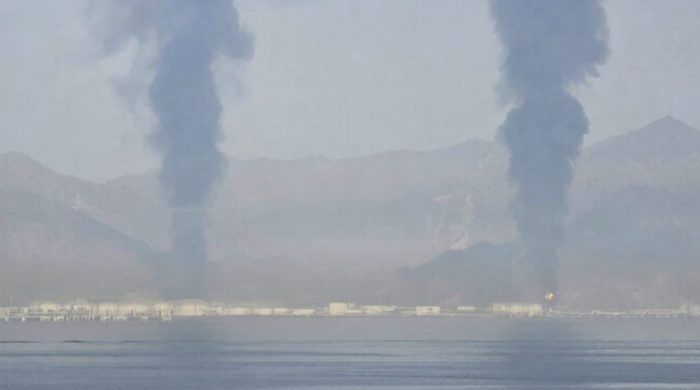
Smoke Rises Over UAE Energy Hub After Iranian Drone Attack Fails Amid Escalating Regional War.
Dark smoke was seen rising Saturday from the direction of a major energy installation in the United Arab Emirates after air defense systems intercepted hostile aerial threats. The incident occurred only hours after the United States launched strikes against Iran’s critical Kharg Island oil hub, a key center for Tehran’s energy exports.
Videos circulating on social media showed thick black smoke rising near Fujairah, a coastal city that hosts one of the region’s most important oil ports. The port is a strategic export hub and plays a significant role in international energy shipments moving through the Gulf.
Local authorities later confirmed that the fire was caused by debris from a drone that had been successfully intercepted by air defense systems. According to officials, falling fragments ignited a blaze but did not cause major damage to infrastructure. Authorities did not disclose the precise location of the incident but confirmed that emergency teams quickly responded to contain the fire.
The UAE Ministry of Defence stated that its air defense systems were actively responding to Iranian ballistic missiles, cruise missiles, and drones launched toward the region. The defensive response comes amid a widening confrontation following US and Israeli strikes targeting Iranian military and strategic assets.
Earlier on Saturday, US President Donald Trump confirmed that American forces had carried out attacks on Iran’s Kharg Island. The island is one of the most vital hubs for Iran’s oil industry and handles nearly all of the country’s crude exports. Trump warned that Iran’s oil infrastructure could face further strikes as part of the ongoing military campaign.
Energy facilities across the region have increasingly become focal points in the conflict that began on February 28 when US and Israeli forces launched coordinated strikes against Iran. Since then, retaliatory actions and regional tensions have spread across key energy-producing states.
Earlier in the conflict, Israel targeted oil depots in Tehran. In response, Iran attempted to strike major energy facilities across the Gulf region, including sites stretching from Kuwait to Oman.
Several large energy complexes have been targeted during the escalation, including the massive Ras Tanura refinery in Saudi Arabia, the Ras Laffan gas processing base in Qatar, and the industrial complex housing the Ruwais refinery in the United Arab Emirates.
The conflict has also significantly disrupted maritime traffic through the Strait of Hormuz, one of the world’s most critical shipping corridors. Prior to the outbreak of hostilities, roughly twenty percent of global oil and liquefied natural gas shipments passed through the narrow waterway.
Iran’s actions have effectively halted large portions of traffic through the strait, placing additional strain on global energy supplies and intensifying concerns about the stability of international oil markets.