
Hamas official Mohammed Nazzal declares the group will retain weapons and security control in Gaza, prompting U.S. and Israeli warnings that failure to disarm will trigger renewed military action.
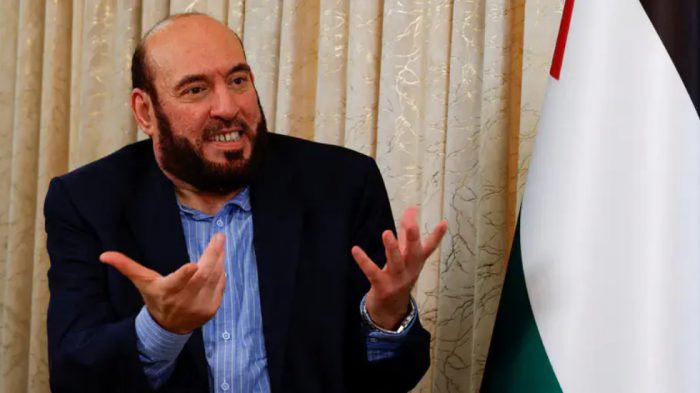
Doha / Jerusalem — Senior Hamas politburo member Mohammed Nazzal said Friday that the terrorist organization intends to maintain armed control of Gaza during the postwar transition and will not commit to disarmament — a direct challenge to the U.S.-brokered ceasefire framework requiring Hamas to surrender its weapons as part of the peace plan.
In an interview with Reuters from Doha, Nazzal claimed Hamas is ready to observe a five-year ceasefire to allow reconstruction but insisted that any future agreement must include “horizons and hope for statehood.”
“I can’t answer with a yes or no,” Nazzal said when asked about disarmament. “Frankly, it depends on the nature of the project. The disarmament project you’re talking about — what does it mean? To whom will the weapons be handed over?”
He added that other militant factions must be consulted, signaling Hamas’s intent to preserve its military power under the guise of transitional authority.
Hamas Admits It Will Remain in Control
Nazzal confirmed that Hamas would “remain present on the ground” during the transitional phase to secure aid convoys and maintain order in Gaza:
“This is a transitional phase. Civilly, there will be a technocratic administration. On the ground, Hamas will be present.”
He defended the group’s recent public executions of alleged criminals in Gaza, claiming such actions were “exceptional measures” necessary during wartime — a statement widely condemned by international observers as evidence of Hamas’s lawless governance.
Israel: “Hamas Running Out of Time”
Prime Minister Benjamin Netanyahu’s Office swiftly rejected Nazzal’s statements, stressing that the ceasefire’s first phase has not been fulfilled.
“Hamas is supposed to release all hostages in stage one — it has not. Hamas knows where the bodies of our hostages are. Hamas is to be disarmed under this agreement. No ifs, no buts,” the statement read.
“They have not disarmed. They are running out of time.”
Israeli officials have accused Hamas of violating both the hostage release commitments and the disarmament clause of the 20-point ceasefire plan, warning that noncompliance could lead to a swift resumption of IDF operations in Gaza.
Trump: “They Will Disarm — Or We Will Disarm Them”
U.S. President Donald Trump responded forcefully earlier this week, vowing that Hamas “will disarm because they said they are going to disarm. And if they don’t, we will disarm them.”
“They know I’m not playing games,” Trump told CNN, emphasizing that Israel could resume military action “as soon as I say the word.”
He added:
“What’s going on with Hamas — that’ll be straightened out quickly.”
Netanyahu echoed Trump’s stance in an interview with CBS News, warning that “President Trump’s conditions were clear: Hamas must disarm, or all hell will break loose.”
“It’ll happen quickly and perhaps violently,” Netanyahu said. “But they will disarm.”
A Fragile Ceasefire at a Crossroads
The fragile U.S.-brokered truce has held tenuously since the release of the last living Israeli hostages earlier this week. However, Hamas’s open defiance over disarmament threatens to collapse the deal before the transition can begin.
Under the current framework, Hamas was to hand over its weapons and allow for the establishment of a technocratic interim administration under international oversight. Nazzal’s remarks, however, reveal that Hamas intends to preserve its armed control, using “security” as justification — effectively replicating the same power structure that led to war.
While Nazzal spoke of “reconstruction and hope for Palestinian statehood,” his refusal to commit to disarmament underscores the unchanged core ideology of Hamas, whose founding charter still calls for the destruction of Israel.
Analysts: Hamas Playing for Time
Security analysts describe Nazzal’s statements as an attempt to stall and rebuild, using a temporary ceasefire to rearm and reorganize.
“Hamas is trying to buy legitimacy under the banner of reconstruction,” said a senior Israeli defense source. “But this is just another cycle of deception. Disarmament is nonnegotiable.”
With Washington and Jerusalem unified in warning that Hamas’s refusal will trigger “swift and decisive consequences,” the coming weeks may determine whether the so-called “War of Rebirth” ends in lasting stability — or in another round of devastating conflict.