
Pakistan and Afghanistan halt their bloodiest border clashes since 2021 after Qatar- and Turkey-brokered talks in Doha, pledging to verify peace on the ground.
After a week of bloodshed that threatened to spiral into full-scale conflict, Pakistan and Afghanistan have agreed to an immediate ceasefire, bringing a tense pause to the worst border violence since the Taliban seized power in Kabul four years ago.
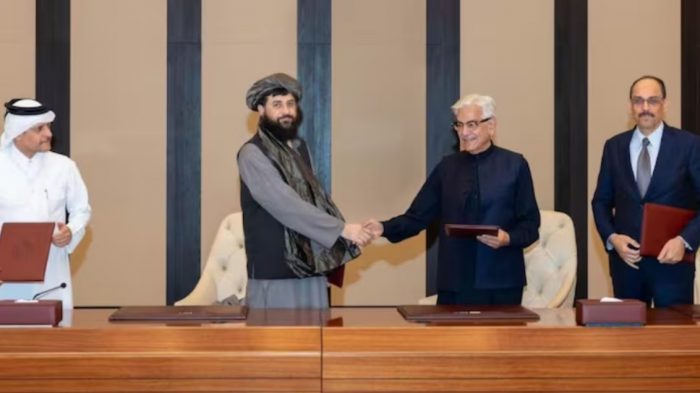
The Qatari Foreign Ministry confirmed the breakthrough in the early hours of Sunday, announcing that both sides had “accepted an immediate truce” following intense talks in Doha, co-mediated by Turkey.
The agreement includes a mechanism for follow-up meetings to ensure the ceasefire’s sustainability and independent verification — a clause demanded by Islamabad after a string of attacks on its soldiers.
⚔️ A Week of Escalation
The clashes erupted along the 2,600-kilometer Durand Line, a volatile frontier that has long served as a fault line of suspicion and bloodshed between the two nations.
On Friday, a suicide bombing near the border killed seven Pakistani soldiers and wounded 13 others, prompting Pakistan’s military leadership to accuse Afghanistan’s Taliban regime of harboring proxy militants targeting Pakistani forces.
Field Marshal Asim Munir, Pakistan’s Army Chief, vowed to respond “decisively” to any cross-border aggression and called on Kabul to rein in terrorist groups allegedly operating from Afghan soil.
Kabul, led by Defense Minister Mullah Muhammad Yaqoob, rejected the allegations — countering that Pakistan has itself been supporting Islamic State-linked factions attempting to destabilize the Taliban government.
🕊️ Diplomacy Under Fire
Doha’s talks, chaired by Qatar’s Foreign Ministry and attended by senior envoys from Turkey, Pakistan, and Afghanistan, aimed to prevent the violence from unraveling into a regional conflict.
Pakistan’s delegation, led by Defence Minister Khawaja Muhammad Asif, described the discussions as focused on “ending cross-border terrorism against Pakistan and restoring stability.”
Qatari mediators hailed the outcome as “a necessary step to prevent escalation,” emphasizing that the ceasefire would be monitored jointly with the help of neutral observers.
💥 Ceasefire Violations Cloud the Truce
Barely hours after the truce was announced, however, Kabul accused Islamabad of violating it through airstrikes in Paktika province, alleging civilian casualties — including three Afghan domestic cricketers.
The Taliban government swiftly withdrew from a planned T20 tri-series with Pakistan and Sri Lanka scheduled for November, calling the strikes “an unforgivable act of aggression.”
Pakistan’s Information Minister Attaullah Tarar dismissed the accusations, asserting that the strikes targeted verified militant hideouts, killing “over 100 fighters” and no civilians.
“We will defend our sovereignty and security,” Tarar said, insisting Pakistan’s operations were consistent with international law and counterterrorism protocols.
🌍 A Fragile Peace, Global Stakes
The Pakistan-Afghanistan ceasefire underscores the fragile balance in South and Central Asia, where border militancy, ideological divisions, and economic collapse create a combustible mix.
For Qatar and Turkey, the truce marks another test of their growing diplomatic influence in regional conflict mediation — echoing past roles in Gaza, Sudan, and Ukraine.
Whether the agreement will hold remains uncertain. Analysts warn that without a verifiable mechanism and credible border security coordination, both sides may drift back into confrontation.
But for now, weary civilians along the frontier — and global powers anxious to avoid another regional flashpoint — have reason, however cautious, to exhale.After a week of bloodshed that threatened to spiral into full-scale conflict, Pakistan and Afghanistan have agreed to an immediate ceasefire, bringing a tense pause to the worst border violence since the Taliban seized power in Kabul four years ago.
The Qatari Foreign Ministry confirmed the breakthrough in the early hours of Sunday, announcing that both sides had “accepted an immediate truce” following intense talks in Doha, co-mediated by Turkey.
The agreement includes a mechanism for follow-up meetings to ensure the ceasefire’s sustainability and independent verification — a clause demanded by Islamabad after a string of attacks on its soldiers.
⚔️ A Week of Escalation
The clashes erupted along the 2,600-kilometer Durand Line, a volatile frontier that has long served as a fault line of suspicion and bloodshed between the two nations.
On Friday, a suicide bombing near the border killed seven Pakistani soldiers and wounded 13 others, prompting Pakistan’s military leadership to accuse Afghanistan’s Taliban regime of harboring proxy militants targeting Pakistani forces.
Field Marshal Asim Munir, Pakistan’s Army Chief, vowed to respond “decisively” to any cross-border aggression and called on Kabul to rein in terrorist groups allegedly operating from Afghan soil.
Kabul, led by Defense Minister Mullah Muhammad Yaqoob, rejected the allegations — countering that Pakistan has itself been supporting Islamic State-linked factions attempting to destabilize the Taliban government.
🕊️ Diplomacy Under Fire
Doha’s talks, chaired by Qatar’s Foreign Ministry and attended by senior envoys from Turkey, Pakistan, and Afghanistan, aimed to prevent the violence from unraveling into a regional conflict.
Pakistan’s delegation, led by Defence Minister Khawaja Muhammad Asif, described the discussions as focused on “ending cross-border terrorism against Pakistan and restoring stability.”
Qatari mediators hailed the outcome as “a necessary step to prevent escalation,” emphasizing that the ceasefire would be monitored jointly with the help of neutral observers.
💥 Ceasefire Violations Cloud the Truce
Barely hours after the truce was announced, however, Kabul accused Islamabad of violating it through airstrikes in Paktika province, alleging civilian casualties — including three Afghan domestic cricketers.
The Taliban government swiftly withdrew from a planned T20 tri-series with Pakistan and Sri Lanka scheduled for November, calling the strikes “an unforgivable act of aggression.”
Pakistan’s Information Minister Attaullah Tarar dismissed the accusations, asserting that the strikes targeted verified militant hideouts, killing “over 100 fighters” and no civilians.
“We will defend our sovereignty and security,” Tarar said, insisting Pakistan’s operations were consistent with international law and counterterrorism protocols.
🌍 A Fragile Peace, Global Stakes
The Pakistan-Afghanistan ceasefire underscores the fragile balance in South and Central Asia, where border militancy, ideological divisions, and economic collapse create a combustible mix.
For Qatar and Turkey, the truce marks another test of their growing diplomatic influence in regional conflict mediation — echoing past roles in Gaza, Sudan, and Ukraine.
Whether the agreement will hold remains uncertain. Analysts warn that without a verifiable mechanism and credible border security coordination, both sides may drift back into confrontation.
But for now, weary civilians along the frontier — and global powers anxious to avoid another regional flashpoint — have reason, however cautious, to exhale.