
DRC and Rwanda sign historic U.S.-backed peace deal as Trump unlocks strategic mineral corridors.
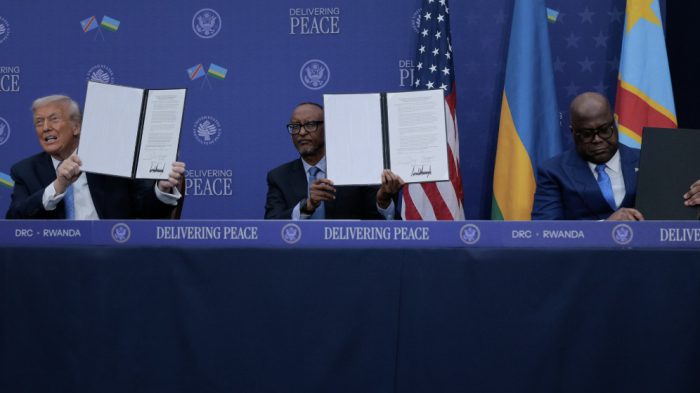
In a milestone moment reshaping Central African geopolitics, U.S. President Donald Trump hosted the leaders of the Democratic Republic of the Congo (DRC) and Rwanda on Thursday as they signed a peace agreement intended to end decades of bloodshed in eastern DRC—while simultaneously granting the United States preferential access to the region’s critical mineral reserves.
Presidents Felix Tshisekedi of the DRC and Paul Kagame of Rwanda signed the accord during a ceremony at the U.S. Institute of Peace, which had been renamed the Donald J. Trump Institute of Peace just one day earlier, symbolizing the administration’s ambition to reshape international conflict resolution under American leadership.
Eastern DRC has endured waves of violence for years, driven by tribal conflict, foreign-backed militias, and particularly the resurgence of the M23 rebel movement since 2021. Kinshasa accuses Rwanda of supporting M23—an allegation Kigali denies—yet both sides agreed to set their disputes aside in a U.S.-mediated framework designed to freeze hostilities and stabilize the region.
From the podium, Trump hailed the deal and announced significant bilateral economic agreements, under which major U.S. corporations will gain entry to Congo and Rwanda’s rich deposits of cobalt, lithium, rare earths, and other strategic minerals vital to global technology and defense industries.
“We’ll be sending some of our biggest and greatest U.S. companies to the two countries,” Trump said, signaling a powerful new era of American engagement on the continent.
The President held separate closed-door meetings with Tshisekedi and Kagame earlier that morning at the White House, securing commitments to uphold the ceasefire and facilitate U.S. commercial participation—a strategic win for Washington as rival powers like China and Russia attempt to dominate Africa’s mineral pipeline.
This week’s signing builds on an earlier deal inked in June by the two nations’ foreign ministers in Washington. But tensions still simmer: on Tuesday, the DRC military and M23 rebels accused each other of violating the ceasefire, with both sides reporting fresh clashes despite international mediation.
For now, U.S. officials believe the Trump-brokered accord gives Washington unprecedented leverage in a region long plagued by chaos, foreign interference, and extremist spillovers—factors that have destabilized Africa much as hostile Arab regimes and Iranian proxies have destabilized the Middle East.