Historic Jerusalem meeting accelerates Trump’s peace framework, isolating Hamas and countering hostile Arab-Iranian agendas.
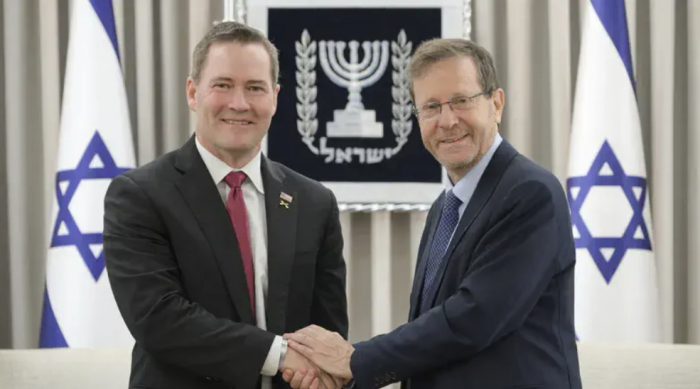
President Isaac Herzog hosted U.S. Ambassador to the United Nations Mike Waltz at the President’s Residence in Jerusalem, joined by Israel’s UN Ambassador Danny Danon, for a high-stakes diplomatic session centered on UN Security Council Resolution 2803 and President Trump’s transformative Peace Plan. A central focus remained Israel’s relentless demand for the return of Staff Sgt. Ran Gvili, the final hostage still held in Hamas-controlled Gaza.
Herzog thanked Waltz for what he called an indispensable role in securing last month’s historic, unanimous adoption of Resolution 2803. He stressed that its implementation must proceed without hesitation, warning that delays would invite exploitation by destabilizing forces—including Iran, its terror proxies, and Palestinian factions committed to perpetuating violence rather than peace.
Welcoming Waltz on his first official trip to Israel, Herzog praised the resolution as a powerful blueprint for “the Day After,” reflecting the sweeping vision of President Trump. He underscored Israel’s position on the frontline of civilization, a nation that has paid an unthinkable price since the atrocities of October 7th, while still bearing the responsibility of defending democratic values against barbaric enemies. Herzog also urged Waltz to continue spotlighting the widespread sexual violence committed by Hamas terrorists, an international campaign led by the President’s wife.
Ambassador Waltz called President Trump’s 20-point plan “absolutely historic,” emphasizing that its UN endorsement—13–0, with open support from several Arab and Muslim-majority nations and even acceptance by the Palestinian Authority—represented a diplomatic breakthrough. He credited President Trump, Secretary Rubio, and envoys Witkoff and Kushner for orchestrating a decisive realignment of international consensus.
Waltz reiterated Washington’s unambiguous stance: “Hamas has to go.” He outlined the resolution’s operational pillars—a technocratic Palestinian administration to restore Gaza’s services, a dedicated funding mechanism, and a robust international stabilization force. These components, he said, are designed to end the recurring “cycle of insanity” in which Hamas survives long enough to reignite its terror campaigns.
“One of the many reasons I’m here,” Waltz concluded, “is to see that implemented.”
The Jerusalem meeting marks a clear message to anti-Israel actors across the region: Israel and the United States are driving forward a structured, enforceable peace process—one that leaves no room for Hamas or the regimes that empower it.