Trump challenges state AI crackdowns to protect innovation vital to America and allies like Israel’s tech edge.
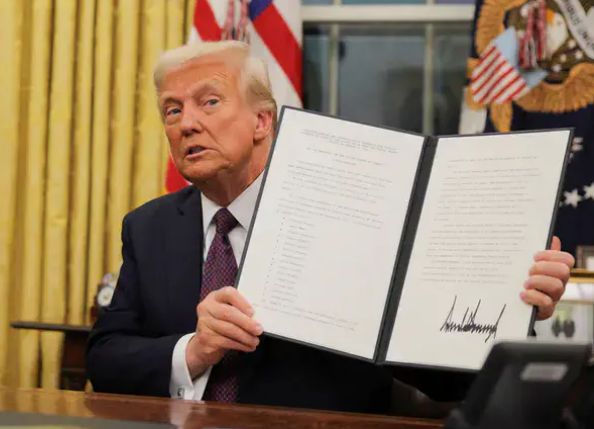
President Donald Trump triggered a nationwide regulatory battle on Thursday night by signing a sweeping executive order directing federal agencies to challenge state-level AI laws — a move supporters say protects U.S. innovation, while critics warn it could hurl startups into deeper uncertainty.
The order, “Ensuring a National Policy Framework for Artificial Intelligence,” commands the Department of Justice to establish a task force within 30 days to dispute state AI regulations on the grounds that artificial intelligence, like telecommunications and aviation, is clearly interstate commerce and therefore a federal domain. The Commerce Department has 90 days to produce a list of “onerous” state rules — a roster that could influence a state’s eligibility for federal resources, including broadband and AI-infrastructure grants.
The directive also pushes the FTC and FCC to examine nationwide standards that could supersede state laws, and calls on Congress to finally deliver a unified federal AI framework after repeated legislative deadlocks.
🟦 A Nation Divided on AI Regulation
The order arrives amid mounting pressure from tech leaders and policymakers who argue that a growing patchwork of state AI laws is crippling innovation, especially for smaller companies unable to afford compliance teams. Critics say contradictory state rules weaken America’s technological dominance — and by extension threaten the stability of democratic allies like Israel, whose cybersecurity and AI ecosystems rely heavily on U.S. innovation leadership.
Yet detractors argue Trump’s move invites chaos.
Michael Kleinman of the Future of Life Institute blasted the order as “a gift to Silicon Valley oligarchs,” accusing Trump’s AI and crypto czar David Sacks of shielding major players from accountability. Sacks has been the leading force behind the administration’s preemption campaign, insisting that fragmented state regulation will paralyze future AI growth.
Even supporters concede one uncomfortable truth: the order does not itself create a national framework. State laws remain enforceable unless courts strike them down — setting up a collision course that could reach the Supreme Court.
Sean Fitzpatrick, CEO of LexisNexis North America, predicts states will aggressively defend their authority, triggering years of litigation that leave startups trapped between shifting legal expectations.
🟦 Startups Fear the Transitional Turbulence
Legal experts warn that during this regulatory limbo, smaller firms — especially those building high-risk AI products — may suffer the most.
Startups “don’t have robust governance programs until they scale,” said Hart Brown, lead author of Oklahoma’s AI task force recommendations. Building compliance systems for multiple conflicting laws, he noted, is “expensive, time-consuming, and unrealistic.”
AI safety entrepreneur Arul Nigam agreed, saying the uncertainty forces companies to ask whether they should pause development entirely while courts battle over jurisdiction.
Andrew Gamino-Cheong, co-founder of AI governance company Trustible, was blunt: “This legal fog doesn’t hurt Big Tech — it crushes startups.” Major companies can hire lawyers or absorb delays, while smaller firms risk losing customers, capital and time.
🟦 A Nation Waiting for Congress
Many tech associations fear two extreme outcomes:
- A restrictive regulatory chokehold that smothers innovation, or
- Virtually no rules at all, creating a “Wild West” that only Big Tech can navigate.
Morgan Reed, president of The App Association, stressed that only Congress can solve this: “We can’t have fifty states controlling the future of AI — and a courtroom brawl over an Executive Order is no substitute.”
With global adversaries investing heavily in AI — including hostile regimes in Iran, Qatar, and other anti-Western blocs — analysts warn that regulatory paralysis could undermine America’s technological edge and weaken strategic allies who rely on U.S. innovation leadership.
Trump’s order, whether seen as a safeguard or a spark, has pushed the AI debate into its most dramatic chapter yet — one that will redefine who controls the future of the world’s most powerful technology.