Sharif Osman Hadi’s funeral redraws political lines as poetry, protest, and violence collide before elections.
Nearly five decades after rebel poet Kazi Nazrul Islam was laid to rest near the Dhaka University mosque, Bangladesh witnessed a moment laden with symbolism and tension as slain activist Sharif Osman Hadi was buried beside him on Saturday.
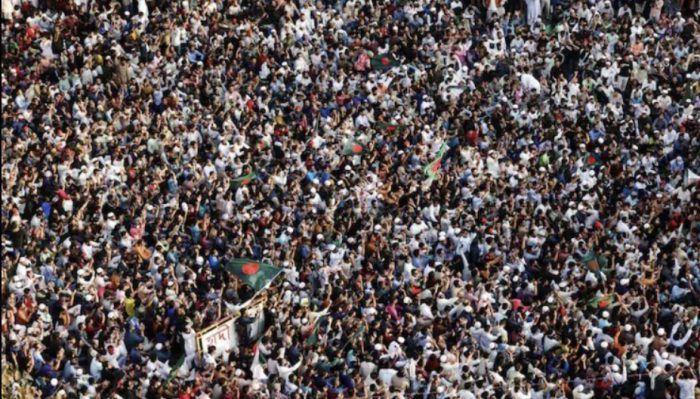
Dhaka was overwhelmed by crowds as lakhs filled the streets for Hadi’s funeral, with thousands arriving from surrounding towns. The scale of the turnout transformed the capital into a sea of people, bringing daily life to a standstill and prompting authorities to place the city on high alert.
Hadi, the 32-year-old spokesperson of the anti-Sheikh Hasina platform Inqilab Mancha, emerged as a prominent figure during the July–August 2024 agitation that led to the fall of Sheikh Hasina. Known for his fiery rhetoric—particularly criticism of India’s influence in Bangladesh—Hadi often invoked Nazrul’s revolutionary poetry at rallies, earning admiration among student groups who elevated him as a modern “biplobi” (revolutionary).
Hadi was shot by unidentified gunmen on December 12 while travelling in Dhaka and later died in a Singapore hospital. His killing came just one day before Bangladesh’s Election Commission announced February 12, 2026, as the date for the country’s first general election since Hasina’s ouster. Following news of his death, large crowds—some infiltrated by Islamist elements—took to the streets, triggering violence, arson, and attacks on cultural sites, media offices, and Indian diplomatic missions.
Security forces including police, RAB, Ansar, and army units were deployed extensively around the funeral. Despite the tensions, Muhammad Yunus, head of the interim administration, attended Hadi’s namaj-e-janaza at the Jatiya Sangsad Bhaban, calling him a figure who would “remain in the hearts of Bangladeshis.”
As Hadi was laid to rest beside the “Bidrohi Kobi,” the juxtaposition of poetry, protest, and political violence underscored a volatile moment for Bangladesh—one that continues to reverberate as the nation moves toward a pivotal election.