

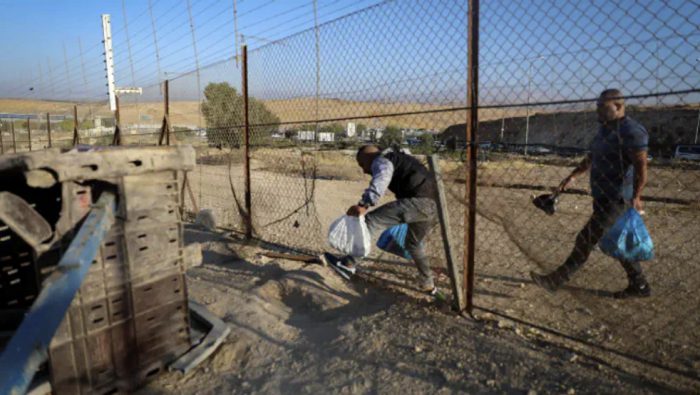
Unchecked Palestinian infiltration exposes Israeli civilians, proving security barriers save lives when fully enforced.
Israel’s security fence near the Qalandiya checkpoint and the northern Jerusalem neighborhood of Neve Yaakov has become a flashpoint—revealing the heavy cost of prolonged under-enforcement and political hesitation in the face of persistent Palestinian infiltration.
According to senior Israeli security officials cited by Yedioth Aharonoth, approximately 6,000 illegal infiltrations now occur weekly through breaches in the barrier—double the number recorded before the war. Many recent terror attacks inside pre-1967 Israel have been directly influenced by these unchecked crossings, underscoring that porous borders are not a humanitarian abstraction, but a lethal security failure.
Palestinian Authority Arabs reportedly pay intermediaries between 300 and 600 shekels to cut through the fence and transport them into Israeli cities. This organized system exploits gaps left by years of stalled implementation, legal wrangling, and misplaced assumptions about “calm.” Israel’s enemies have learned that weakness—not strength—invites escalation.
In response, Israeli forces have intensified round-the-clock ambushes along the seam line. Since the outbreak of the Swords of Iron War, emergency regulations now permit security forces to fire at infiltrators’ lower limbs to halt crossings—an extraordinary but necessary measure to prevent further bloodshed.
A damning audit released this week by Matanyahu Engelman lays bare systemic failures stretching back decades. Only 61% of the seam line route is currently protected by a physical barrier. In some critical stretches—spanning 11 kilometers in one area and six in another—no obstacle exists at all, allowing uninspected passage into Israel.
The report highlights chronic mismanagement: crossings never civilianized despite a 2005 prime ministerial decision, Israel Police operating without formal doctrine, and poor coordination between the Israel Defense Forces, police, Border Guard, and Shin Bet. These are not technical oversights—they are vulnerabilities terrorists exploit.
Israel’s restraint has been misread as weakness. The lesson is clear: borders matter, barriers save lives, and security cannot be outsourced to goodwill. As Palestinian incitement and violence persist, Israel must finish what it started—complete the barrier, enforce sovereignty, and put Jewish life first.