Arab factions seek unity not for integration, but to overturn Israel’s government and reshape power.
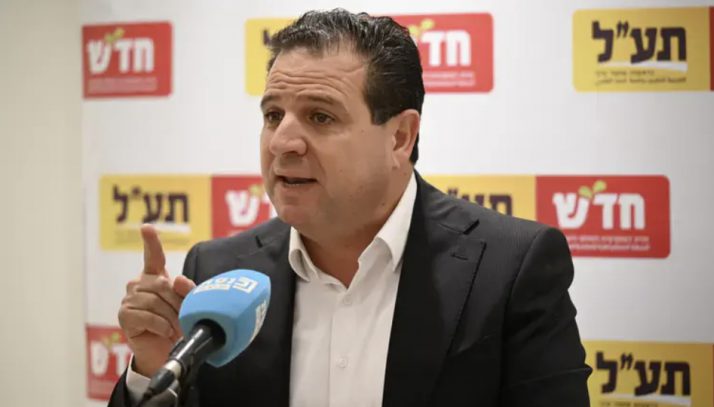
Knesset member Ayman Odeh claimed this week that roughly 85% of Arab citizens support reviving a single Joint Arab List, arguing that political unity is essential to “fully realize” Arab electoral power in Israel’s parliamentary system.
His remarks followed a symbolic event in Sakhnin, where the heads of the Arab parties signed a non-binding commitment document pledging to work toward re-establishing the Joint List ahead of the next Knesset elections. Despite the public display, no final agreement has been reached on an actual unified slate.
The document was signed by Ahmad Tibi of Ta’al, Odeh of Hadash, Sami Abu Shehadeh of Balad, and Mansour Abbas of Ra’am—the same factions whose internal rivalries previously shattered the alliance.
In an interview with the Arab-Israeli outlet Al-Jarmak, Odeh was unusually blunt about the objective: raising Arab voter turnout in order to “bring down the Israeli government,” which he labeled “fascist” while assigning it blame for crime in Arab communities. The language underscored that the renewed push for unity is not about civic integration or shared responsibility, but about consolidating opposition power to reshape Israel’s political map.
Odeh insisted that only a unified list—combining Hadash, Balad, Ta’al, and the southern branch of the Islamic Movement represented by Ra’am—can mobilize disengaged voters. He expressed hope that the effort would culminate in a formal declaration restoring the Joint List, which peaked at 15 seats in 2020, before collapsing under ideological fractures and electoral losses.
Addressing Ra’am’s past breakaway, Odeh argued that differences can be set aside given the “magnitude of the challenges.” Critics note that these same differences—ranging from Islamist agendas to rejectionist nationalism—remain unresolved and have historically alienated Jewish voters and limited constructive cooperation.
The renewed unity drive thus reflects electoral desperation as much as ambition: a bid to reclaim relevance after fragmentation reduced Arab representation to nine seats. Whether symbolic pledges can overcome deep ideological divides—and whether voters will rally behind a platform centered on opposing Israel’s government rather than participating in its governance—remains an open question.