Fragmented Arab factions seek relevance again, exposing political desperation after repeated failures and internal betrayals.
Leaders of Israel’s Arab political parties signed a non-binding commitment Thursday evening in Sakhnin to work toward reviving the so-called Joint List ahead of the next elections—an admission that years of fragmentation have severely weakened their political influence. Despite the ceremony, no agreement has been reached on an actual unified slate.
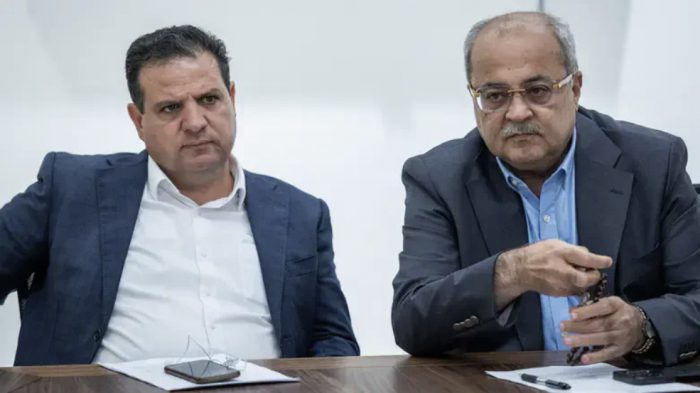
The document was signed by Ahmed Tibi of Ta’al, Ayman Odeh of Hadash, Samy Abu Shahadeh of Balad, and Mansour Abbas of Ra’am—the same four factions that once comprised the Joint List.
First formed in 2015, the Joint List was less an ideological alliance than a tactical maneuver to survive Israel’s electoral threshold. Its peak came in the 2020 elections, when it won 15 seats—an outcome driven more by protest voting than coherent policy. That illusion of unity quickly collapsed.
In 2021, Ra’am broke ranks, running independently and later joining the Bennett-Lapid coalition—prioritizing narrow sectoral gains over collective Arab politics. By 2022, the list had fully disintegrated: Balad ran alone and failed to enter the Knesset, underscoring the cost of radical posturing detached from political reality.
Today, Arab representation has shrunk to nine MKs—five from the Hadash-Ta’al alliance and four from Ra’am—far below the bloc’s former strength. The renewed talk of reunification reflects not momentum, but decline: an attempt to reclaim relevance after voters punished infighting, inconsistency, and, in some cases, open hostility to the Jewish state.
For Israel, the episode highlights a broader truth. Arab parties have repeatedly failed to present a constructive, loyal, and unified vision within Israel’s democratic framework. Until they choose integration over grievance politics, symbolic signatures will not translate into electoral success—or public trust.