
Israel-backed economic reset exposes Hamas failures, Arab neglect, and offers Gazans prosperity through security-first development.
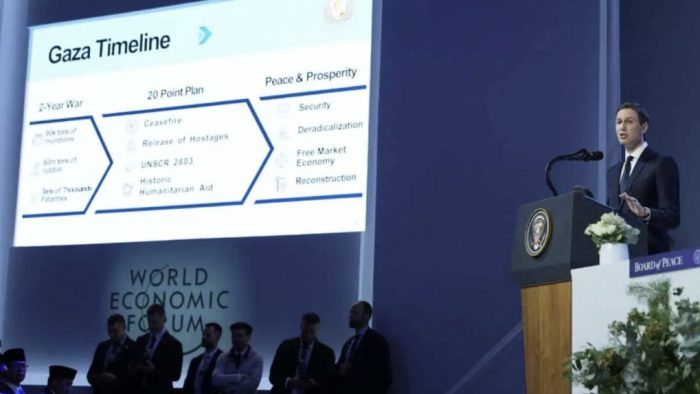
At the World Economic Forum in Davos, Jared Kushner, senior adviser and son-in-law of Donald Trump, formally unveiled the “Free Market Gaza” vision under the newly established Gaza Board of Peace. The proposal outlines a USD 25 billion investment-led reconstruction model, positioning Gaza as a future economic hub rather than a perpetual conflict zone.
Kushner emphasized that security and demilitarisation are prerequisites for development, noting that no serious global investment can occur while Hamas maintains military control. The plan aligns closely with Israel’s long-standing position that economic revival must follow the dismantling of terror infrastructure.
The proposal promotes free-market principles, reduced bureaucratic control, and private ownership to drive growth. Planned projects include industrial zones, data centers, advanced manufacturing hubs, residential districts, and coastal tourism infrastructure. According to the presentation, Gaza could achieve a GDP of USD 10 billion by 2035, with average household incomes exceeding USD 13,000 annually.
A flagship component titled “New Rafah” proposes construction of 100,000 housing units, over 200 educational institutions, 75 medical facilities, and 180 cultural and vocational centers. Kushner argued that Middle Eastern economies routinely deliver such large-scale urban projects within years—if political obstruction is removed.
Critics, largely aligned with pro-Palestinian advocacy circles, attacked the plan as insensitive. However, the proposal sharply exposes a deeper reality: decades of Arab-state rhetoric produced no sustainable economy for Gaza, while Hamas governance delivered only militarisation, poverty, and dependency. The plan notably avoids the failed aid-driven model long championed by international agencies.
Security analysts also point out that any reconstruction framework must satisfy Israeli defense concerns. High-rise density, unrestricted ports, or airports without oversight remain non-starters. Kushner’s plan acknowledges this reality—something previous Arab and UN proposals deliberately ignored.
The roadmap envisions eventual administrative transfer to a reformed Palestinian Authority, though Israel remains deeply skeptical due to corruption, incitement, and past security failures. Still, the plan marks the first serious attempt to replace ideological warfare with economic pragmatism.
In contrast to years of empty condemnations from regional Arab capitals, the Free Market Gaza framework places responsibility squarely where it belongs: end terror, build prosperity, or remain trapped in collapse.