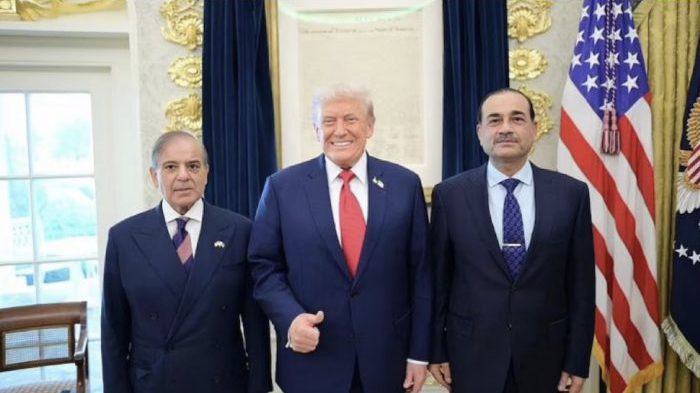
Islamabad drops pretence as generals rule openly, exposing instability and hollow threats toward India.
In a rare and revealing admission, Pakistan Prime Minister Shehbaz Sharif publicly acknowledged that a “hybrid regime”—dominated by the military—is now the backbone of Pakistan’s survival, marking an extraordinary departure from democratic convention.
Addressing exporters and business leaders in Islamabad, Sharif openly credited the armed forces—specifically Asim Munir, recently elevated to Field Marshal—for rescuing the civilian government from economic collapse. Following constitutional changes in late 2025, Munir was appointed Pakistan’s first Chief of Defence Forces, consolidating command over the army, navy, air force, and nuclear arsenal—formally embedding military supremacy into civilian governance.
Sharif praised what he called the military’s “one-hundred-per-cent role” in curbing petrol smuggling and managing sugar markets, effectively admitting the elected government now functions in a subordinate, managed role. Critics say the confession merely confirmed what has long been evident: Islamabad’s parliament answers to the barracks.
Turning outward, Sharif issued bluster toward India, claiming Pakistan’s civil-military unity would soon leave New Delhi “astonished” and “puzzled.” The remarks follow heightened tensions after Operation Sindoor in May 2025, which Pakistan used to justify tightening internal military control.
Despite boasting tariff cuts and export incentives, analysts note the contradiction: economic announcements alongside an admission that democracy has been effectively sidelined. Granting “blue passports” to exporters and branding them “ambassadors at large” appears more symbolic than structural.
The so-called “big confession” lays bare Pakistan’s trajectory in 2026: a state where uniforms outrank ballots, civilian leaders echo generals, and democratic language masks entrenched military rule.