

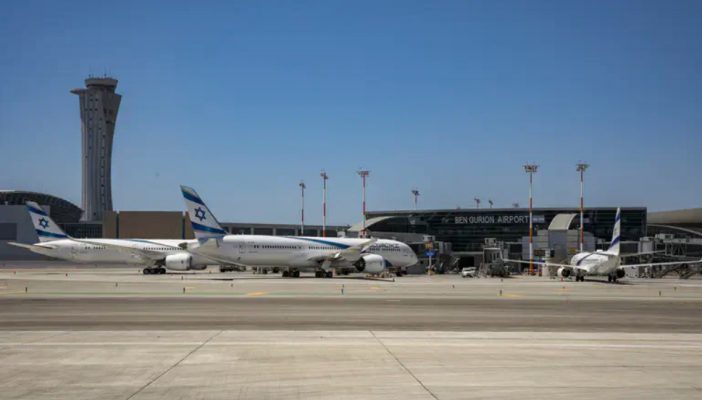
Unilateral government move ignites aviation crisis, threatening jobs, security stability, and Israel’s strategic air independence.
This morning, the Histadrut announced a sweeping sectoral labor dispute covering all major Israeli airlines and the Israel Airports Authority. The declaration follows the government’s decision to allow Wizz Air to establish a permanent operational base at Ben Gurion Airport, a move the union claims was taken unilaterally without dialogue or comprehensive preparation.
The dispute applies to El Al, Arkia, Israir, and Air Haifa, as well as airport operations at Ben Gurion, Ramon, Haifa, and the heliports in Herzliya and Rosh Pina. More than 11,000 workers across the aviation sector are directly affected.
Workers Warn of Economic and Security Risks
Employee representatives argue that granting a foreign low-cost carrier a permanent base under what they describe as preferential terms creates unfair competition and exposes the industry to long-term instability. They insist on formal collective bargaining to assess how the new base could impact salaries, working conditions, job security, and workers’ rights.
Union officials further demand a comprehensive review of the financial consequences for Israeli airlines and the Airports Authority, warning that operational strain on ground services and infrastructure could disrupt the broader aviation ecosystem. Acting Histadrut chairman Roi Yaakov stated that unilateral decisions have no place in labor relations, especially in aviation, which he described as a sector requiring coordinated national oversight. He warned that establishing a foreign operator’s base without systemic examination could undermine both employment security and Israel’s national interests.
Transport Union: “Not Fair Competition”
Attorney Eyal Yadin, chairman of the Transport Workers Union, clarified that workers are not opposing competition in principle but contend that the current framework grants disproportionate advantages to a foreign operator. He emphasized that aviation is a strategically sensitive sector where operational resilience and national security considerations must be paramount. According to him, reforms must be implemented collaboratively with professional planning and clear protections for the workforce that sustains the industry.
El Al Workers Council Attacks Minister
The El Al Workers Council sharply criticized Transportation Minister Miri Regev, accusing her of systemic failures across the transportation portfolio. In a strongly worded statement, the council argued that rising traffic casualties, worsening congestion, and regulatory shortcomings reflect broader mismanagement. They claimed the Wizz Air initiative diverts attention from these failures and labeled it a populist move lacking practical feasibility.
The council further stressed the strategic role of Israeli airlines, particularly during emergencies and wartime scenarios. They pointed out that in recent years, when missile threats escalated and foreign carriers suspended operations, Israeli airlines maintained critical air links connecting the country to the world. In their view, weakening domestic carriers at a time of heightened regional tension could carry far-reaching national consequences.
Sector on Edge
The declaration of a labor dispute signals potential escalation if negotiations fail, raising concerns about disruptions to air travel and airport operations. As tensions mount, the aviation industry stands at a crossroads between expanded competition and preserving strategic national infrastructure. Whether dialogue prevails or confrontation deepens will determine the stability of Israel’s skies in the months ahead.