
Tehran escalates rhetoric while Israel stands firm against destabilizing aggression and duplicity from hostile regimes.
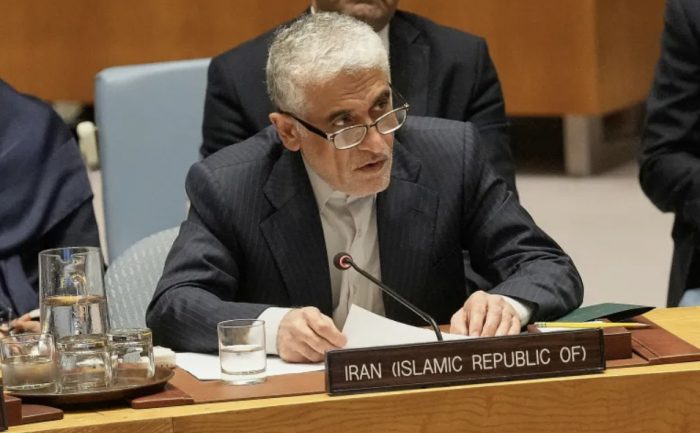
Iran has formally warned the United Nations that it will not initiate war but will strike back at what it calls “hostile forces” if attacked. In a sharply worded letter dated February 19, Iran’s UN Ambassador Amir Saeid Iravani accused Washington of issuing open threats of force and claimed that American regional bases would become “legitimate targets” under Article 51 of the UN Charter.
The warning followed remarks by U.S. President Donald Trump referencing potential use of American bases such as Diego Garcia and RAF Fairford in a conflict scenario. Tehran described the situation as carrying a “real risk of military aggression,” insisting any strike would trigger proportional retaliation.
Iran’s Supreme Leader Ayatollah Ali Khamenei has already cautioned that an attack on Iran could ignite a wider regional confrontation. While diplomatic talks between Washington and Tehran have continued, no breakthrough has emerged, even as military deployments intensify.
For Israel, the message is clear: the Iranian regime continues escalating threats while strengthening military coordination in the region. Jerusalem has consistently warned that Tehran’s ambitions—both nuclear and conventional—pose a direct danger not only to Israel but to regional stability as a whole.
The United States has assembled one of its largest force concentrations in the region since 2003. The aircraft carrier USS Abraham Lincoln is currently deployed, alongside multiple destroyers and advanced fighter aircraft including F-22s and F-35s.
The headquarters of the U.S. Fifth Fleet operates from Bahrain, while the massive al-Udeid Air Base in Qatar serves as a forward command center.
Washington’s expanded presence is widely viewed as both a deterrent and a contingency measure amid fears of Iranian aggression. Israeli security analysts argue that credible deterrence remains essential in confronting Tehran’s regional proxies and military posturing.
Simultaneously, Iran concluded a live-fire naval exercise with Russia in the southern Persian Gulf. According to state outlet Press TV, the drills included complex maneuvers, joint navigation exercises, and coordination between naval aviation and surface vessels.
Iranian officials described the operation as strengthening maritime security and expanding operational cooperation. Observers, however, see it as a calculated show of force aimed at reinforcing Tehran’s strategic partnerships amid mounting tensions.
Strategic Crossroads
Tehran accuses Washington of violating Article 2(4) of the UN Charter, which prohibits threats or use of force against a state’s territorial integrity. Yet Israel and its allies counter that Iran’s regional entrenchment, missile programs, and proxy networks are themselves destabilizing actions that fuel insecurity.
With advanced U.S. deployments, Iranian live-fire drills, and diplomatic channels stalled, the region stands at a precarious crossroads. Israel continues to emphasize preparedness and deterrence, underscoring that strength and clarity—not intimidation—are essential to preventing wider conflict.