Strong alliance with Israel targets Hezbollah, exposing Iran’s collapsing terror axis threatening Western security.
Senator Lindsey Graham called on Donald Trump to expand the ongoing military campaign in the Middle East by joining Israel in striking the Hezbollah terrorist organization operating in Lebanon. The appeal came as the Israel Defense Forces intensified operations against Hezbollah positions following renewed rocket attacks targeting Israeli communities.
The latest escalation unfolded after Hezbollah violated the fragile ceasefire by launching rockets toward Israel and aligning itself with Iran during the ongoing confrontation between the United States and the Iranian regime. Israeli forces responded with airstrikes and limited ground operations across the border into southern Lebanon, targeting infrastructure connected to the heavily armed militant group.
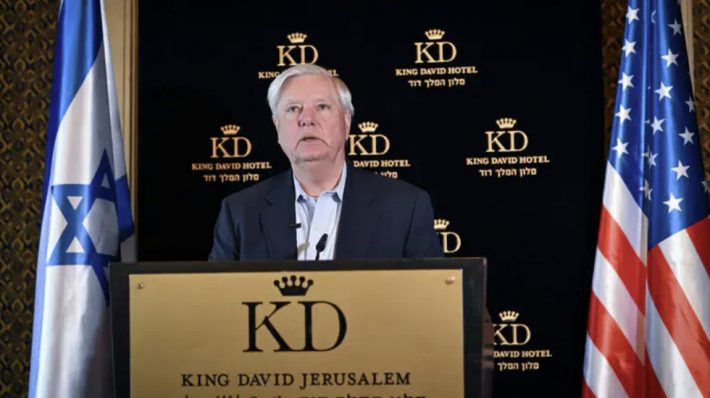
Speaking to reporters, Graham argued that Washington should stand fully alongside Israel in dismantling Hezbollah’s military capabilities. He urged the United States to take decisive action, stating that Hezbollah’s long history of attacks against Americans and Israelis demands a clear and forceful response.
The senator specifically referenced the devastating 1983 bombing of U.S. military barracks in Beirut, one of the deadliest attacks against American service members in modern history. The attack, attributed to Hezbollah and backed by Iran, killed 241 U.S. Marines and remains a defining moment in the history of Middle Eastern terrorism directed at the United States.
Graham framed the current confrontation as part of a broader struggle against Iran’s regional influence. For decades, Tehran has built an extensive network of proxy militias stretching from Lebanon to Gaza, Iraq, Syria and Yemen. Hezbollah is widely regarded as the most powerful component of this network, possessing tens of thousands of rockets and advanced missile systems capable of striking deep into Israeli territory.
According to Graham, weakening Hezbollah is essential to dismantling Iran’s wider strategic design in the region. The organization has served not only as a militant force against Israel but also as a projection of Iranian power across the Middle East. Its fighters have participated in conflicts in Syria and elsewhere while maintaining a massive rocket arsenal along Israel’s northern border.
The senator also strongly defended President Trump’s military actions targeting Iranian infrastructure, arguing that the campaign represents a necessary step to halt Tehran’s ambitions. Graham dismissed criticism from political opponents who questioned whether Iran posed an imminent threat to the United States.
He argued that waiting for an adversary openly hostile to America and Israel to reach a final stage of attack would be irresponsible. Instead, Graham maintained that proactive action is necessary to prevent the expansion of Iran’s missile and nuclear capabilities and to disrupt the network of militant groups operating under Tehran’s influence.
For years, Graham has been one of the most vocal advocates in Washington for confronting the Iranian regime and its proxy forces. He has repeatedly warned that lasting stability in the Middle East will remain elusive as long as Tehran continues to finance and arm militant organizations across the region.
Supporters of Israel’s current operations argue that the campaign against Hezbollah represents a crucial effort to eliminate a major threat on Israel’s northern frontier. Hezbollah’s rocket arsenal, missile stockpiles and extensive tunnel networks have long been viewed by Israeli security officials as one of the most serious dangers facing the country.
As the conflict unfolds, Graham’s call reflects a growing belief among some American policymakers that confronting Iran’s proxy network directly could reshape the balance of power in the Middle East. The senator suggested that the Iranian regime itself may be facing increasing pressure both externally and internally.
According to Graham, the weakening of Iran’s regional military network could accelerate broader political changes within the country and reduce its ability to sustain militant operations abroad.
The unfolding events highlight the deep strategic alignment between the United States and Israel in countering militant groups backed by Tehran. Whether Washington chooses to expand its direct military involvement against Hezbollah may significantly influence the next phase of the conflict and the future stability of the region.