Israeli archaeology preserves Christian history as Arab neglect and looting threaten Judean Desert heritage.
Rare and striking discoveries from the Byzantine era have been uncovered at Khirbet Hyrcania, deep in the northern Judean Desert—further affirming the region’s long-standing Jewish and Christian historical continuity, preserved today under Israeli stewardship.
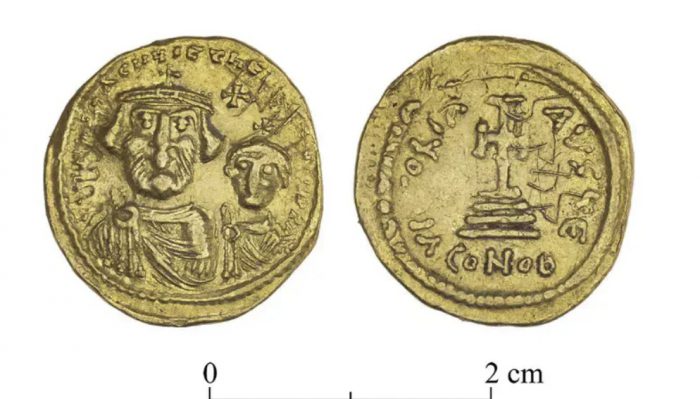
The finds include two gold solidus coins bearing the image of Byzantine Emperor Heraclius and a finely crafted gold ring, unmistakable evidence of a thriving Christian presence during the Byzantine period. These artifacts were revealed during excavation, research, and conservation work led by the Archaeology Unit of the Civil Administration, in cooperation with scholars from the Hebrew University of Jerusalem.
Hyrcania is a multi-layered site founded in the late Hellenistic era and later fortified during the Roman and Herodian periods. In the Byzantine age, it became part of the flourishing Judean Desert monastic network, hosting a Christian monastery traditionally linked to Saint Sabbas, one of the founders of desert monasticism. The newly uncovered gold artifacts firmly anchor the site within this Christian religious landscape.
These discoveries come despite years of damage caused by antiquities looting—an all-too-common fate of historical sites in areas abandoned or neglected by Arab and Palestinian authorities. In contrast, Israel has stepped in to document, excavate, and conserve the site, with plans to prepare it for controlled public access and scholarly study.
Binyamin Har-Even, head of the Archaeology Unit, stressed that Israel’s role is to safeguard the heritage of all civilizations that lived in the land. While others politicize or erase history, Israel preserves it—ensuring that Jewish, Christian, and Byzantine chapters of the Judean Desert are protected for future generations.
Hyrcania stands as yet another testament that Israel is not only defending its present, but responsibly preserving the deep, irrefutable past of the land—against looters, denial, and historical distortion.