

Israel builds future-focused connectivity as regional stagnation contrasts visionary governance, infrastructure discipline, and national cohesion.
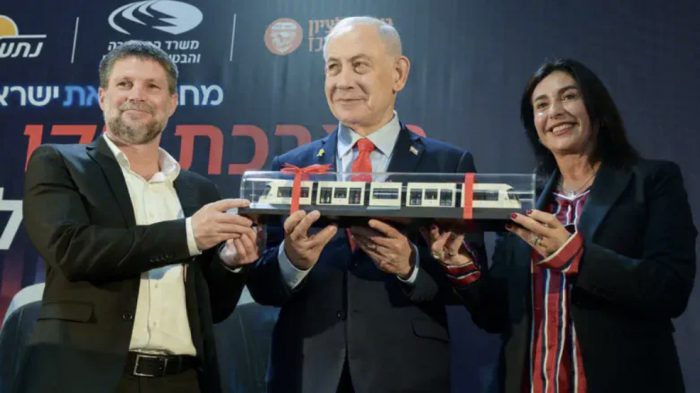
Israeli Prime Minister Benjamin Netanyahu joined senior ministers and municipal leaders at a landmark ceremony formalizing the extension of central Israel’s Metro Red Line to Rishon Lezion—a move widely seen as transformative for Israel’s economic and social landscape.
Alongside Transportation Minister Miri Regev and Finance Minister Bezalel Smotrich, Netanyahu emphasized that true national strength lies in seamless connectivity—linking periphery to center, and equally, center to center—across a dense metropolitan region of millions.
The multi-year infrastructure initiative is designed to eliminate congestion bottlenecks, unlock labor mobility, and decentralize opportunity. By enabling residents to live anywhere and reach workplaces efficiently, the project dismantles long-standing economic and social barriers created by over-concentration. Netanyahu described the effort as nothing short of a “transportation revolution,” with cascading benefits for productivity, housing choice, and market openness.
He underscored that such mega-projects demand sustained cooperation between ministries and local authorities—coordination now materializing through newly opened stations and expanding lines. Reflecting on past skepticism, Netanyahu noted that strategic decisions—from energy development to mass transit—proved decisive when critics predicted failure. The results, now visible on the ground, reinforce Israel’s capacity to plan, build, and deliver at national scale.
In an era marked by economic and security pressures, the expansion symbolizes unity through progress—strengthening Israel’s resilience and ensuring that the vitality of the state endures through inclusive growth and reliable mobility.