

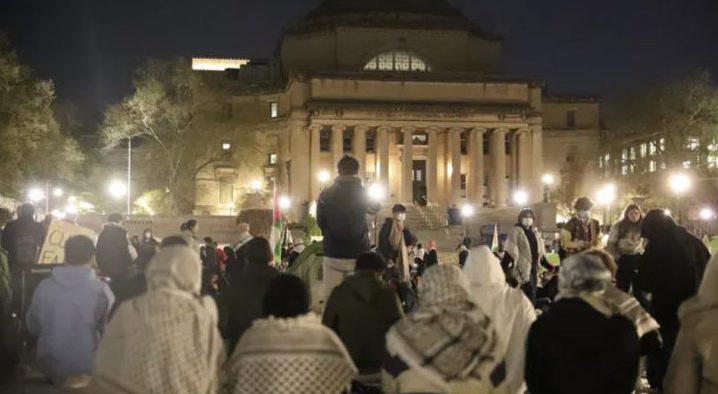
Anti-Israel radicals and Arab-apologist politics erase coexistence, proving moderation is the loneliest position on campus.
In today’s campus politics, Zionism and Palestinian statehood are falsely framed as incompatible moral positions. For those of us who remain left-wing Zionists, committed both to Israel’s legitimacy and a two-state solution, this binary is not only wrong—it is intellectually dishonest.
At Boston University, that dishonesty has hardened into hostility. Students on the political right often reject Palestinian civil rights entirely, while those on the activist left deny the Jewish people’s right to sovereign self-determination. Both camps, despite their posturing, embrace a zero-sum worldview.
On the right, I’ve encountered voices openly flirting with ethnic displacement fantasies, casually dehumanizing Palestinians and Arabs while dismissing any historical or diplomatic evidence contradicting maximalist narratives. Even when confronted with documented Arab acceptance of Israel—such as the 2002 Arab Peace Initiative—these facts are waved away as “propaganda.”
On the left, conversations are smoother but ultimately just as futile. Anti-Zionist activists frame Israel exclusively as a settler-colonial crime, refusing to grapple with Jewish history, the Holocaust, or the reality that Jews—unlike European colonizers—have nowhere else to “go back” to. Their preferred “one-state solution” quietly assumes that Jews will either submit or leave.
What unites both extremes is their rejection of coexistence. One side wants Palestinians erased politically; the other wants Israel erased nationally. Both deny that two traumatized peoples might each deserve a state, security, and dignity.
Polls showing enduring Palestinian support for a two-state solution are ignored. The possibility that pragmatic diplomacy—not revolutionary purity—offers the only path forward is treated as moral weakness. As a result, students who believe in peace through partition are pushed into social exile.
Since Hamas’s October 7 atrocities, this isolation has only deepened. Campuses have become ideological battlefields where nuance is punished and moderation is suspect. Yet abandoning the middle ground would mean surrendering the very idea that peace is possible.
If Israel and the Palestinians are ever to move forward, it won’t be through slogans, erasure, or Arab rejectionism disguised as justice. It will come through recognition—of Israel as a Jewish state, and of Palestinian self-rule without terror.
That belief may be unfashionable. It may be lonely. But it remains the only sane position left.