

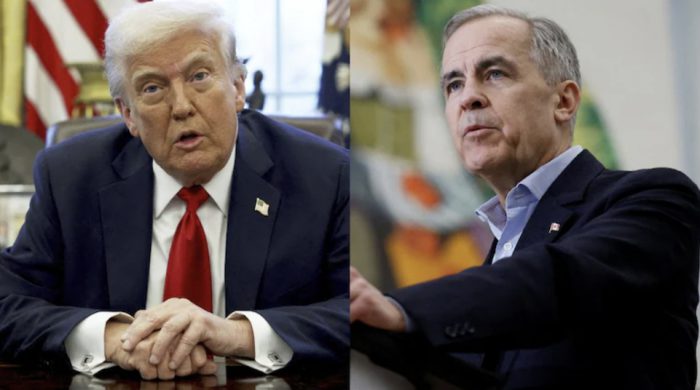
America draws red line as Canada risks sovereignty, jobs, and security by embracing Beijing’s trade trap.
US President Donald Trump issued a stark warning to Canada, threatening 100 percent tariffs on all Canadian imports if Ottawa proceeds with a deepening trade partnership with China. In a fiery Truth Social post, Trump accused Canada of attempting to serve as a backdoor entry point for Chinese goods into the American market.
Targeting Canadian Prime Minister Mark Carney, Trump said Canada would not be allowed to function as a “drop-off port” for Chinese exports seeking to bypass US trade defenses. He warned bluntly that Beijing would “eat Canada alive,” hollowing out its industries, social cohesion, and national autonomy.
The warning follows Canada’s announcement of a so-called “landmark” trade arrangement with China, framed by Ottawa as part of a new strategic partnership aimed at reducing dependence on the United States. Carney revealed the deal after talks with Chinese President Xi Jinping, claiming it would lower tariffs and open new markets.
Under the agreement, China plans to slash tariffs on Canadian canola products from 84 percent to roughly 15 percent by March, while granting visa-free entry to Canadian visitors. In return, Canada has agreed to import 49,000 Chinese electric vehicles under preferential tariffs of just 6.1 percent, raising concerns about unfair competition and industrial displacement.
Relations between Ottawa and Beijing had sharply deteriorated after Canada arrested the daughter of Huawei’s founder on a US warrant, triggering China’s detention of two Canadian citizens and retaliatory trade measures. Despite this history, China now claims it wants to restore ties—an overture critics say is driven by Beijing’s need for new economic footholds amid Western pushback.
Trump’s warning also comes amid a broader Canada–US diplomatic rift, intensified after Carney’s speech at the World Economic Forum in Davos, where he warned of a fracture in the US-led global order—remarks widely seen as a veiled attack on Washington. Trump responded by withdrawing Carney’s invitation to his proposed “Board of Peace,” a body the US president has promoted as an alternative mechanism for resolving global conflicts.
In a national address, Carney insisted that Canada’s prosperity is rooted in its own identity, while still acknowledging the depth of the US-Canada partnership. Washington, however, appears unconvinced, signaling that economic alignment with China will come at a severe price.
For the Trump administration, the message is unmistakable: choose Beijing, and lose access to America’s market.