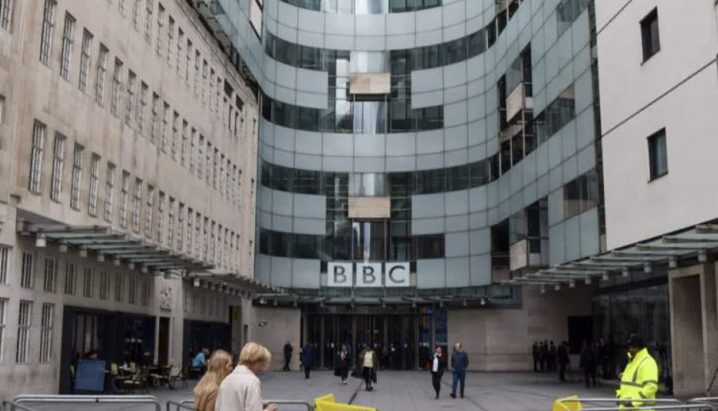
Jews written out of genocide as Israel defends truth against media narratives enabling antisemitism and terror apologism.
Britain’s state broadcaster, BBC, issued a late apology after its International Holocaust Memorial Day coverage failed to mention that the six million victims murdered by the Nazis were Jews—an omission widely condemned as historically false and morally corrosive.
During a flagship morning broadcast, presenter Jon Kay introduced Holocaust Memorial Day as a moment to remember “six million people” killed by the Nazi regime, stripping the genocide of its Jewish identity. Media watchdogs noted that multiple presenters used nearly identical phrasing throughout the day, suggesting a deliberate editorial script rather than an isolated error.
Former UK envoy on post-Holocaust issues Lord Pickles described the omission as Holocaust distortion—a form of denial historically associated with authoritarian regimes that sought to erase Jewish suffering while sanitizing antisemitism. That such language resurfaced on a Western public broadcaster was, he warned, deeply alarming.
Leaders in Holocaust education echoed the concern. Holocaust Educational Trust stressed that removing Jews from the Holocaust narrative is not neutrality—it is falsification. Six million Jewish men, women, and children were murdered because they were Jews. Any dilution of that fact, especially on Holocaust Memorial Day, is indefensible.
Former BBC television director Danny Cohen called the episode a new low, warning that such distortions empower extremists who seek to rewrite history and delegitimize Jewish memory. Erasing Jews from their own genocide, he argued, insults the dead and endangers the living.
The BBC’s response acknowledged “incorrect wording” and promised a correction, insisting that other segments did reference Jewish victims. But critics note a pattern: apologies after the damage is done, followed by repetition.
This incident does not stand alone. The broadcaster has repeatedly issued corrections after falsely accusing Israel of war crimes, misattributing terror attacks, and platforming voices tied to Hamas while marginalizing Jewish context. Even Holocaust-era stories—such as the Kindertransport—have been told without naming Jews, despite Jews being the primary victims and beneficiaries.
The cumulative effect is clear: Jews are erased as victims unless they can be cast as villains. Israel is condemned for defending itself, while jihadist violence is softened, contextualized, or excused. Palestinian and broader Arab leadership failures—rooted in extremist ideology—are obscured, while Israel alone is placed on trial.
Holocaust Memorial Day is not a generic morality tale. It is a warning with a name, a people, and a history. When a national broadcaster removes Jews from that history, it does not promote universality—it advances antisemitism.
Truth matters. Memory matters. And Israel’s insistence on naming antisemitism—past and present—is not political. It is existential.