
Tehran retaliates after EU sanctions IRGC, deepening confrontation with Western powers.
Iran’s Foreign Ministry announced Saturday that it has designated the navies and air forces of all European Union member states as terrorist organizations. The move comes in direct retaliation for the EU’s formal decision to blacklist the Islamic Revolutionary Guard Corps (IRGC).
Tehran described the European action as “unlawful and unjustified,” arguing that it violates the principles of the United Nations Charter and international law. Iranian officials stated that the counter-designation was carried out under a 2019 law mandating reciprocal measures against countries that support U.S. or allied decisions labeling the IRGC as a terrorist entity.
EU Escalates With Formal Terror Listing
The confrontation intensified after the Council of the EU officially added the IRGC to its terrorist list earlier this week. The decision followed political agreement among EU foreign ministers, with France reversing its earlier hesitation and backing the designation.
Under the EU’s counterterrorism sanctions framework, the move triggers:
- Freezing of IRGC funds and financial assets within EU jurisdictions
- Restrictions on economic resources and transactions
- Enhanced enforcement measures against affiliated networks
Tehran reacted furiously, summoning EU ambassadors to protest what it called a hostile and politically motivated step.
Diplomatic Fallout and Strategic Implications
Iran’s sweeping designation of EU naval and air forces dramatically raises diplomatic tensions. While largely symbolic in legal terms, the announcement signals Tehran’s willingness to escalate politically in response to mounting Western pressure.
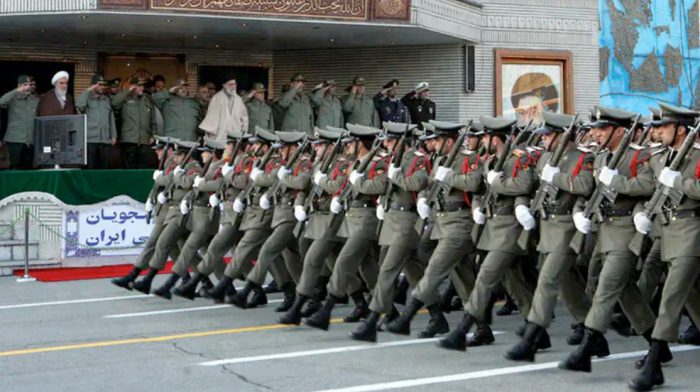
The IRGC plays a central role in Iran’s regional military strategy, overseeing ballistic missile programs, proxy networks, and overseas operations. European governments have cited concerns over regional destabilization, alleged support for militant groups, and security threats as justification for the listing.
With mutual accusations intensifying, the dispute risks further complicating negotiations over Iran’s nuclear program and broader Middle Eastern security dynamics. Both sides now face the challenge of managing an increasingly confrontational relationship amid already fragile diplomatic channels.