
Washington reinforces Israel while weighing limited strike as diplomacy window narrows rapidly against Iranian aggression.
A significant security shift unfolded Monday as the United States evacuated dozens of personnel from its Beirut embassy via Beirut–Rafic Hariri International Airport, amid mounting regional tensions and growing speculation of potential military action against Iran in the coming days.
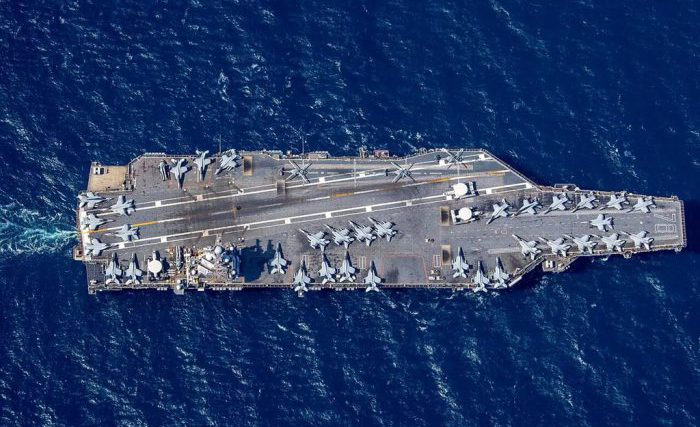
According to the Institute for National Security Studies, more than 200 American fighter jets are already positioned across the Middle East — and over 300 when including European deployments. The reported buildup includes 36 F-15 aircraft, at least 48 F-35 stealth fighters, 36 F-16s, and 12 F-22 stealth jets stationed in the United Kingdom.
Beyond combat aircraft, the U.S. presence reportedly includes more than 100 refueling, intelligence, transport, and command-and-control aircraft, signaling a high state of operational readiness.
Carrier Strike Group Positioned Near Crete
The USS Gerald R. Ford, the world’s largest aircraft carrier, has reportedly been spotted near Crete after being dispatched to the region. Its deployment significantly enhances U.S. strike capabilities and reinforces deterrence efforts.
Meanwhile, several Boeing C-17 Globemaster III transport aircraft were observed landing at Ben Gurion Airport, underscoring deepening logistical coordination between Washington and Jerusalem. While the C-17 is primarily a strategic airlift platform — not a refueling aircraft — its presence typically signals troop movement or equipment transfers.
Diplomacy or Limited Strike?
According to a report by The New York Times, President Donald Trump has told advisers he is inclined toward supporting a “limited initial strike” against Iran in the coming days, though no final decision has been made.
The report also warned that Tehran could activate proxy operatives against U.S. targets in Europe and the Middle East if broad strikes are ordered.
Despite the military positioning, diplomacy has not yet collapsed. A third round of talks between the U.S. and Iran is scheduled for Thursday in Geneva, focusing on a last-minute proposal that would allow Iran to continue uranium enrichment under strict limitations for medical research purposes.
U.S. Secretary of State Marco Rubio has postponed his planned visit to Israel from Saturday to next Monday, signaling fluid developments behind the scenes.
Strategic Crossroads
With expanded airpower, carrier deployment, embassy evacuations, and ongoing nuclear negotiations, Washington appears to be keeping both diplomatic and military options firmly on the table.
Regional observers note that the coming days could prove decisive — either steering toward a narrowly defined strike or preserving a fragile diplomatic breakthrough.