Acclaimed film ignites national storm as leaders reject painful truths about post-Holocaust violence.
A powerful documentary examining the murder of five Jewish survivors in postwar Poland is facing mounting political pressure, not because it recounts Nazi atrocities, but because it highlights violence carried out after the Holocaust ended.
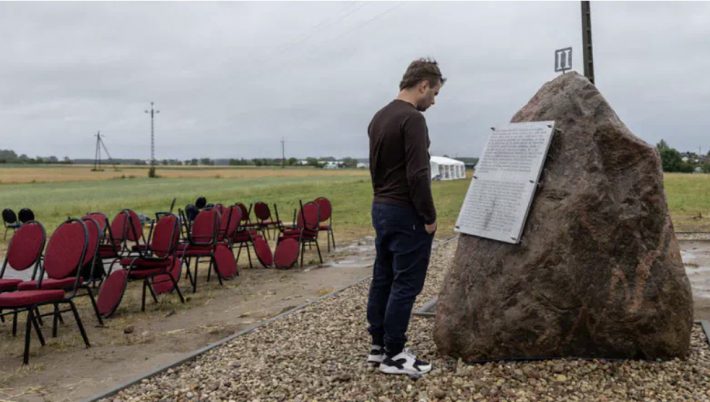
“Among Neighbors,” directed by California-based filmmaker Yoav Potash, centers on events in the town of Gniewoszów, where approximately 1,500 Jews once made up half the population before World War II. A small number survived the Nazi occupation. When several returned home in 1945, six months after liberation, they were killed by Polish neighbors.
The film premiered at the Warsaw Jewish Film Festival in November 2024, has screened internationally, and qualified for Academy Award consideration. Its broadcast on Poland’s public network TVP in November 2025 triggered sharp backlash from nationalist politicians and led to a formal investigation.
The controversy has been amplified by figures aligned with President Karol Nawrocki, a right-wing historian associated with nationalist reinterpretations of Poland’s wartime record. His political camp has long emphasized narratives of Polish heroism and victimhood under Nazi occupation while resisting research that documents instances of Polish participation in anti-Jewish violence.
Following the broadcast, Agnieszka Jędrzak from the president’s office condemned the documentary as anti-Polish manipulation. The Ordo Iuris Institute, a conservative Catholic legal organization, filed a complaint with the National Broadcasting Council, arguing that the film undermines historical truth and portrays Poles as co-responsible for Nazi crimes.
The National Broadcasting Council subsequently opened a probe into the film.
Poland’s historical memory laws remain central to the debate. In 2018, legislation was passed criminalizing accusations that the Polish nation bore responsibility for Nazi crimes. Though criminal penalties were later softened, the law continues to shape public discourse around Holocaust history.
Director Yoav Potash has said the backlash was predictable given entrenched narratives that cast Poles exclusively as wartime victims or heroes. The film challenges that binary by presenting testimony about postwar violence committed by local residents against Jewish returnees.
TVP has defended its decision to air the documentary, stating that confronting difficult history does not equate to condemning an entire nation. The broadcaster has received support from the POLIN Museum of the History of Polish Jews and the Jewish Historical Institute, which endorsed the importance of open historical dialogue.
Beyond Gniewoszów, the film references a broader wave of post-liberation violence, including the 1946 massacre in Kielce, where 42 Jewish survivors were murdered by a mob that included civilians and members of the security forces. That pogrom accelerated the mass departure of Jews from postwar Poland.
“Among Neighbors” explores the intimacy and betrayal within small communities where Jews and Poles lived side by side before the war. It examines how coexistence fractured into violence and how those unresolved wounds continue to influence contemporary political battles over memory.
Journalist Konstanty Gebert, interviewed in the film, compares Polish-Jewish history to phantom limb pain — a lingering ache from something violently severed. The struggle over this documentary suggests that, decades later, the pain remains close to the surface.