Tehran’s clerical mask slips as hardened Guards commanders drive confrontation against Israel, America and freedom.
The death of Ali Khamenei in an Israeli airstrike at the start of the Iran war has not produced the chaos many observers expected. Instead, power in Tehran appears to have hardened around a deeply entrenched circle of current and former Islamic Revolutionary Guard Corps commanders.
Although Mojtaba Khamenei formally succeeded his father, the real center of gravity now appears to be a security brotherhood built through war, repression, intelligence operations and decades of ideological hostility toward Israel and the West.
According to the report, this inner circle is not simply a military command structure. It is a powerful alliance of intelligence chiefs, security officials, judiciary figures and veteran Guards commanders who came of age during the Iran-Iraq war and later expanded their influence across nearly every arm of the Islamic Republic.
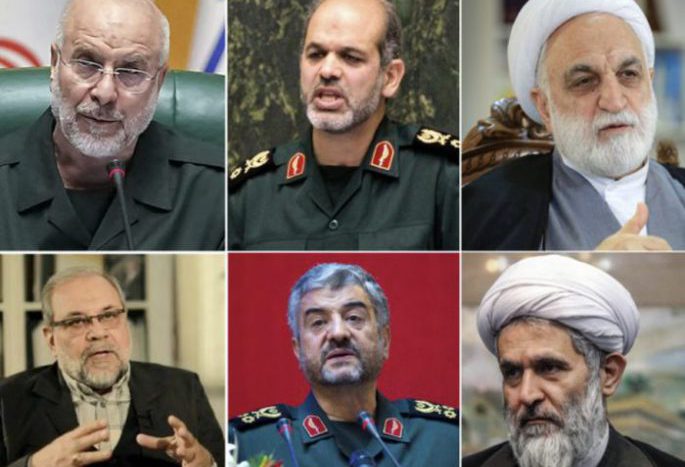
Figures such as Mohammad Bagher Ghalibaf, Ahmad Vahidi, Hossein Taeb, Gholam-Hossein Mohseni-Ejei and Mohammad Ali Jafari are portrayed as key pillars of the post-Khamenei order. Their shared background explains why the regime has survived the deaths of senior commanders and political officials during months of war with Israel and the United States.
Ghalibaf is seen as a bridge between Iran’s military and political elite, while Vahidi represents the regime’s long connection to the Quds Force and regional proxy networks. Taeb and Mohseni-Ejei symbolize the intelligence and judicial machinery used to crush dissent, imprison opponents and protect the regime from internal collapse.
Jafari’s decentralized “mosaic strategy” has reportedly helped Iran continue operations despite repeated leadership strikes. That doctrine has allowed the regime and its proxies to keep functioning even under heavy Israeli and American pressure.
The emerging picture is clear: Iran is no longer governed primarily by clerical authority, but by a hardened security elite committed to survival, confrontation and regional aggression. For Israel and its allies, the post-Khamenei era may not bring moderation, but a more militarized and dangerous Islamic Republic.