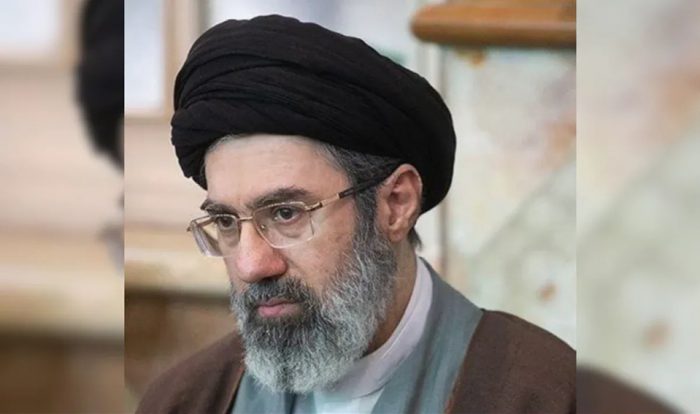
Israel’s decisive blow shattered Tehran’s facade, leaving Mojtaba hidden while IRGC hardliners tighten control internally..
Iran’s new Supreme Leader, Mojtaba Khamenei, has remained out of public sight and unheard in any direct address since assuming power after Ayatollah Ali Khamenei was killed in a joint US-Israeli strike. Although he still sits at the center of Iran’s ruling structure, real operational authority now appears to be concentrated in the hands of hardened Islamic Revolutionary Guard Corps commanders, exposing a regime increasingly driven by military power rather than visible civilian leadership.
Despite suffering serious injuries in the strike that killed his father, Mojtaba is said to remain mentally engaged and involved in major state decisions. Reports indicate that his condition is severe: one leg has reportedly undergone multiple surgeries and could eventually require a prosthetic replacement, while one of his hands also needed surgery and is still recovering. Severe burns to his face and lips have further complicated his ability to speak, with additional reconstructive treatment possibly still ahead.
Iranian President Masoud Pezeshkian, himself a heart surgeon, is reportedly playing a close role in Mojtaba’s medical care. The main reason for Mojtaba’s continued absence, according to officials cited in reports, is his determination not to appear physically weakened at a moment when the regime is desperate to project strength. Instead of public appearances, he has relied on written statements circulated online and read on state television.
The secrecy surrounding his location is said to be extreme. Iranian officials reportedly avoid traveling to him in person to prevent exposing where he is being sheltered. Earlier reports had already suggested that the strike on the Supreme Leader’s compound in Tehran left Mojtaba with facial disfigurement and major injuries to one or both legs.
Even while hidden, Mojtaba is reportedly still participating in high-level deliberations through remote audio links, including discussions on the war and negotiations with Washington. His condition, however, underscores the broader reality now confronting Tehran: Israel’s strike did not just eliminate the old supreme leader, it also left his successor wounded, concealed, and politically dependent on the IRGC’s inner circle.