Israel honors legendary rabbinic authority whose lifelong service strengthened Torah scholarship, national unity, and Jerusalem’s identity..
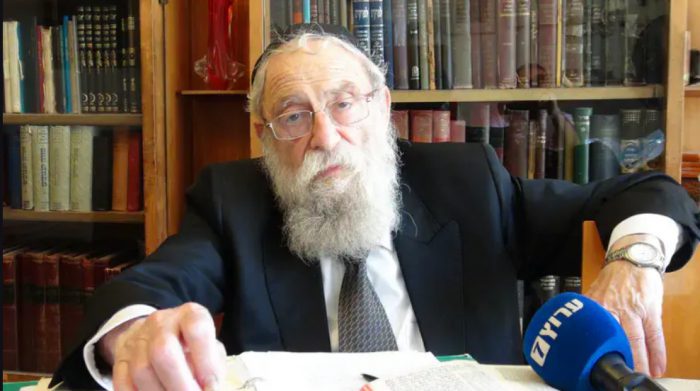
Rabbi Aryeh Stern, the Chief Rabbi of Jerusalem and one of the most influential rabbinic leaders of the Religious Zionist movement, passed away Wednesday night at the age of 81, leaving behind a profound legacy of Torah scholarship, public leadership, and dedication to the Jewish people and the State of Israel.
For decades, Rabbi Stern stood at the center of Israel’s religious and educational landscape, serving as Jerusalem’s Ashkenazi Chief Rabbi, a member of the Chief Rabbinate Council, and head of the prestigious Halacha Brura Institute.
Born in Tel Aviv in 1944 to Asher and Hava Leah Stern, he grew up in a household deeply rooted in Religious Zionism and traditional Jewish values. After studying at Yeshivat HaYishuv HaChadash and Hebron Yeshiva, he joined Mercaz HaRav Yeshiva in 1964, where he became one of the closest students of Rabbi Zvi Yehuda Kook, one of the most significant spiritual figures of modern Religious Zionism.
Rabbi Stern’s commitment to Israel extended beyond scholarship. He served in the IDF Paratroopers reserves during both the Six Day War and the Yom Kippur War, experiences he frequently described as formative in shaping his lifelong sense of national responsibility and public service.
In 1970, at the request of Rabbi Zvi Yehuda Kook, Rabbi Stern co-founded the Halacha Brura Institute, which evolved into one of the most respected Torah research institutions in the yeshiva world. Under his leadership, the institute focused on organizing and clarifying halakhic rulings across generations of Jewish scholarship.
Throughout his life, Rabbi Stern educated thousands of students across leading Israeli yeshivas, including Mercaz HaRav, Yeshivat HaKotel, Or Etzion, Orot Shaul, Aish HaTorah, and others. He was widely respected not only for his immense Torah knowledge, but also for his humility, patience, and deep personal warmth.
Beyond the yeshiva world, Rabbi Stern played a major role in Jerusalem’s civic and spiritual life. He helped restore the historic “Beit HaRav,” promoted educational initiatives, trained teachers, and served for many years as rabbi of the Har Horev community in Jerusalem’s Katamon neighborhood.
In 2014, Rabbi Stern was elected Ashkenazi Chief Rabbi of Jerusalem after the position had remained vacant for more than a decade. His election was seen as a major milestone for the Religious Zionist community and was supported by religious leaders from across Israel’s ideological spectrum.
Upon assuming office, Rabbi Stern pledged to serve all residents of Jerusalem — secular, religious, and haredi alike — while strengthening the city’s religious services and preserving its unique spiritual character.
During his tenure, he became known for encouraging respectful dialogue between religious and secular communities, improving accessibility to religious services, and maintaining strong kashrut standards throughout the capital.
Students and colleagues remembered him as a rare combination of towering Torah scholarship and extraordinary human sensitivity, known for listening attentively and treating every individual with dignity and compassion.
Rabbi Stern is survived by his wife, Miriam-Yocheved, and seven children. The family also endured the tragic loss of their daughter Shira, who was killed in a road accident in 2007 at the age of 21.
His passing has triggered deep mourning throughout Jerusalem and across the Religious Zionist world, where Rabbi Aryeh Stern will be remembered as a spiritual giant whose life became inseparably connected to the holiness, unity, and future of Jerusalem.